I Dig October

Technically, of course, I should have waited for Thursday to make this post, but I’m jumping the gun a little so that people don’t miss cool stuff happening at the beginning of the month.

This lawn bowling ball, the oldest in North America, dates from between 1660 and 1715/16.  Image from the Commonwealth Museum.  Click to check it out!

This lawn bowling ball, the oldest in North America, dates from between 1660 and 1715/16. Image from the Commonwealth Museum. Click to check it out!

October is Archaeology Month in Massachusetts, which means that places all over the state from libraries to museums to historical sites to town councils are sponsoring or hosting archaeological activities for the next 30-odd days.  (Some of them may be very odd, but don’t blame me!)  There’s a calendar of events available on the website, and also a great collection of resources for educators, including books, websites, museum links, and links especially for kids.  I don’t get the occasion to say this very often, but –Go Massachusetts Historical Commission!

If you’re curious, my museum, The Discovery Museums in Acton, is offering several archaeology themed programs this upcoming month:

Thursday, October 8
Uncovering the Past
3:00 PM Science Discovery
Uncover various artifacts and food remains including historic pottery, bottles, animal bones and seeds during a mock midden dig led by archaeologist Marty Dudek. Middens, the remains of old trash heaps, are important archeological sites. Try your hand at mending pottery, identifying vessel forms and measuring their size. Identify animal bones and recover seeds through flotation or water sifting. Find out about basic excavation and recovery methods and discover how archeologists learn about diet. This program is sponsored by Red Hat, Inc.

Monday October 12
Preschool Archaeology Dig
10:00 AM Children’s Discovery
Come explore our mock archaeology dig site. What will you discover? Use your “artifacts” to make an artistic collage to commemorate your adventure.

Tuesday, October 27
Pound Like an Egyptian: Papyrus Paper Making
3:00 PM Science Discovery
From the banks of the Nile all the way to The Discovery Museums—these strips of papyrus have a fascinating story.  Celebrate the feast of Thoth with us today, and learn about the way ancient Egyptians used papyrus paper.  Experiment with different techniques to make your own piece to take home!

So keep your eyes open for other archaeology-related posts throughout October!
Windows on the World At Large (And Small!)

Today I bring you a few ‘fun-with-photos’ links.

The Infinite Photograph from National Geographic’s Green Guide — You’ve probably all seen those really cool photocollages: VanGogh’s Starry Night redone through tiny pictures from NASA, Yoda reconstructed with a million Star Wars screencaps, etc.  If you’re anything like me, you’ve wished over and over for a magnifying glass while you were looking at them–fortunately, the folks over at NG seem to be a lot like me.  *wink*  Their Infinite Photograph gives you an opening scene, into which you may zoom to see how it is constructed out of hundreds of other photographs, and keep zooming in until you get an entirely new scene–then start zooming all over again from there.  Not just a really whizbang techno effect, it’s also a collection of incredibly beautiful images from all over the world.  And if you’re lucky, it will also inspire you to pick up your camera and head outdoors.

Miniature_01_camera

Miniature Art — I happened across this collection of photographs/miniatures by accident while working on an Inventors’ Workshop challenge.  There’s something fascinating about seeing the world from the Brobdignagian point of view, and though some of the pictures in this collection are clearly the work of a somewhat quirky sense of humor and propriety, they’re fascinating, fun, and a great way to start a discussion about scale in math, form, function, and design in science, point of view in literature or art, and ‘just why are the Belgians so fond of Mini-Europe anyway?’ in geography.  🙂

Behind the Scenes at the Harvard Museums — Have I mentioned yet my firm belief that a lot of us who work in museums do so because we really like getting to go through the ‘staff only’ doors to see the cool hidden stuff?  Wired Science brings us some really beautiful photos of some of the strangest, coolest, most random hidden favorites from the Harvard Museum of Natural History.  (I notice they do not include the classroom where I had my Urbanization of Ancient Cultures class.  Which was cool.  And dusty.)

And finally, a graphics resource, just for the heck of it.  You have a pretty cool picture for an exhibit/mailing/program/birthday card, but really don’t know how to frame it or what color scheme to use?

Check out Pictaculous, which allows you to load a picture and then will give you a selection of color palettes from which to choose for further graphic design.  It’s a fun tool, and if you’re feeling really brave you can screencap your favorite palette and drop it right into your photo editing program to have available for your color selection tool.

Putting Twitter in a Historical Context?

Wait…really?  Twitter, the ‘so new you have to be part of it to look cool’ mini-status-update gadget that half the world loves to hate already?  Twitter plus history equals something interesting?

Yup.

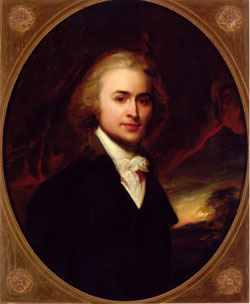
John Quincy Adams as ambassador to Russia

John Quincy Adams as ambassador to Russia

While I admit to being slightly biased about just how cool this organization is, (I worked on the interactive timeline on The Coming of the American Revolution) the Massachusetts Historical Society has gone and done something kind of fun.  This summer marks the 200th anniversary of John Quincy Adams’ voyage to Russia, to the diplomatic post appointed to him by then President Madison.  Though JQA wrote long diary entries as well, he also kept a line-a-day journal with navigational coordinates of their journey and a summary of the day’s highlights–much like today’s Facebook status updates or Twitter posts.  The MHS is doing a daily re-post of those summary entries on Twitter, and also has an overview page about the project available at their main site.

My favorite techno-gadget they’ve included is a progressive Google map tracking JQA’s progress across the Atlantic, linked from the end of most posts.

For further thought:
– What other historical figures would you love to see as a Twitterer or in some other modern guise?
– How else could you use Google maps in another context?  Historical?  To plan out the plot of a story?  Tracking sea turtles? (The New England Aquarium, another institution for which I have a positive bias, has a rehabilitation center that tracks its ‘outpatients.’)

Get lost in National Geographic

Sometime when I was a kid, an aunt bought my family a subscription to National Geographic for the year for a Christmas present, and to my glee, she has renewed it ever since.  The magazine is utterly satisfying in and of itself –the heavy pages with full color illustrations, the map inserts, the incredibly eclectic mingling of ancient history with pages of beetles with the state of modern-day Russia, etcetera etcetera.

To my equal satisfaction, the National Geographic website is similarly detailed, thoroughly engaging, and very likely to envelop your attention for hours once you start clicking on related links and intriguing pictures.  Deaf dolphins, dark energy, the history of ether–you name it, you can probably find something related to it on their website.  A treasure trove for the interdisciplinarily minded–and if you haven’t got the patience for the articles, there’s still a wealth of beautiful pictures, wallpapers, and ‘photos in the news’ to get your curiosity energized.  Or go visit the kids’ site, play the stack-attack game (horribly addicting, do not try this at work unless you have a very good excuse!), and troll the assorted stories, activities, and ‘cool clicks’ to find inspiration for your next lesson plan, program, or bulletin board.

Hint: There are also a range of newsletters you can opt-into, including ones focused on travel, photography, educators, and geography.  They do a great job of highlighting what’s new and cool on the site if you haven’t got time to put the site into your regular rotation of places to surf.

IdeaBox: Altoid Tins

ideabox altoids

In a past life, I must surely have been a magpie.  (Oooh, shiny!)  I have always been an irredeemable collector, and in my current job, I have all the excuses I need to keep bits and pieces around for inspiration.  The areas on, around, and under my desk contain feathers, stones, LEGO’s, rubber ducks, silly putty, macaroni flowers, solar powered toy cars, and a whole box of interesting shaped containers, foam pieces, springs, and whatnots.  From these pieces of rubber tubing, marbles, fabric swatches, and more, I get program and exhibit ideas all the time.

altoids

And so I bring you the fun and funky ideabox links for today: Five Reuses for Altoid Tins.  Planet Green’s top five include building tiny speakers, a solar gadget charger, a wallet, a survival kit, and a geocaching box (think I might have to try some of those!).  Or, for the more artsy among us, a watercolor traveling kit, and create your own travel candle.  (Though I wonder about the heat–I’d recommend putting it on a plate or coaster before burning!)

Here are a few other (less technical!) idea starters:

– Altoid tins are magnetic!  Turn one into a tiny on-the-road game box with magnetic pieces.  What else might you be able to do with magnets and an Altoids box (or two, or three, or more?)
– Glue a mirror in the lid and keep your kleenex in the bottom.  (Don’t you hate how those little plastic packets let your tissues get all shredded in your pocketbook?)
– Sound shakers and mini-cymbals for the extremely young musician, when you’d rather save your pans. (The round tins are particularly good for this one!)
– Start seeds in the world’s tiniest window-boxes.
– Make a fold-out mini-storybook, photo album, or travel journal with accordion-style pages.

Not Just Another Hot Air Popper

hot air popcorn popperWhat is “Brain Popcorn?”

Have you ever had an idea, which reminded you of something you learned in high school, which reminded you of a movie you saw recently, which reminded you of the last trip you took, which reminded you of your oldest friend, which reminded you of a book you’ve been meaning to read?

This is Brain Popcorn.

Have you ever listened to a piece of music, and discovered that it was written at a certain time period that is the same historical era as one of your favorite books, and that the characters in the book, the historical figures of the time, and you could all be listening to the same notes?

This is Brain Popcorn.

Have you ever heard a story on the news that made you go to their website, which led you to a link on a related topic, which spoke to one of your favorite causes or hobbies, which inspired you to pick up a new activity or share it with others?

This is Brain Popcorn.

Brain Popcorn is the successive sparking of ideas, weaving of connections, and resulting understanding and excitement of seeing little pieces of the world connect for you in a whole new way.

So what’s this all about, anyway?

This blog is a place for museum educators, teachers, and anyone who’s interested in barreling through life in an interdisciplinary fashion.  It’s a place for me to share some of my favorite projects and programs from my work at a hands-on science and children’s museum, and a place to gather idea-generators.

Got something fun to share on any topic?  Feel free to *pop* right in.