Brain Popcorn Reboot

It’s a gray, gloomy Friday, but my spirits are up for any number of reasons, chief among them my joy at coming back to Brain Popcorn with fresh inspiration and some new plans for the rest of 2012.  (Some of my New Year’s Resolutions take longer to kick in than others, sorry about that!)

Starting now Brain Popcorn will be back to its once/week posting format, but with added exhibit, book, & article reviews and conference reports as well as the usual interdisciplinary activity roundups.  Keep an eye out for commentary on next week’s NAEA (National Art Educators Association) conference in NYC, and reviews on whatever museums I manage to eke out a visit to while there.  I’ve also been collecting bunches of awesome blogs and artists that I’m looking forward to getting to tell you all about.

And for now, to cheer up your damp Friday afternoon and mine, a charming chain reaction video from those folks I love over at The Tinkering Studio Blog.

Hello, My Name is Curiosity

To my extreme sorrow (and no doubt that of any number of my colleagues at PEM), our Museum Action Corps internship program is drawing to an end.  To celebrate some of the incredible work of the program’s coordinator, Rosario, and her many teams of impressive interns, I thought I would use a few BrainPopcorn posts to highlight my favorite recent intern projects.

Exploring Personal Connections Across Artworks, Curators, and Visitors

Exhibit openings usually have a number of common denominators: VIPs, staff with shiny nametags, refreshments, people mingling with more or less conversation focused on the art.  Maybe there’s some music, there are pretty much always a few minutes of speeches–it’s a fairly predictable pattern.

Which is why, when the museum staff was invited to an intern-created temporary exhibition event, “Connecting Cultures,” I was beyond pleasantly surprised to see the pattern rearranged.

First, we were invited to pick up a name tag–not with our name on it, but instead with a noun we found appealing, or which we felt applied to us.  There were lots of choices: hard work, creativity, entertainment, emotion, etcetera.  Unsurprisingly, I chose
And with our name tag came an accompanying envelope with instructions and a slip of paper inside.  The instructions suggested that we consider and then do these things:

1) Why did you pick your name tag?  (Easy, that.  I don’t think they had ‘Hello, my name is Imagination’ or that would have been more of a battle.)

2) Find the artwork listed on our initial slip, talk to the intern who picked it, make connections between his or her experience and our own, as well as that of any other person visiting the artwork at the same time (This turned out to be very cool, as I learned things about my coworkers which would  never have come up in everyday conversation.)

3) Pick another word associated with that artwork from the group on the table and follow it to the object indicated.  Then think about how that word applied to both artworks.

4) Repeat step 2 until you’ve gone full circle or the time runs out and it’s time for speeches.
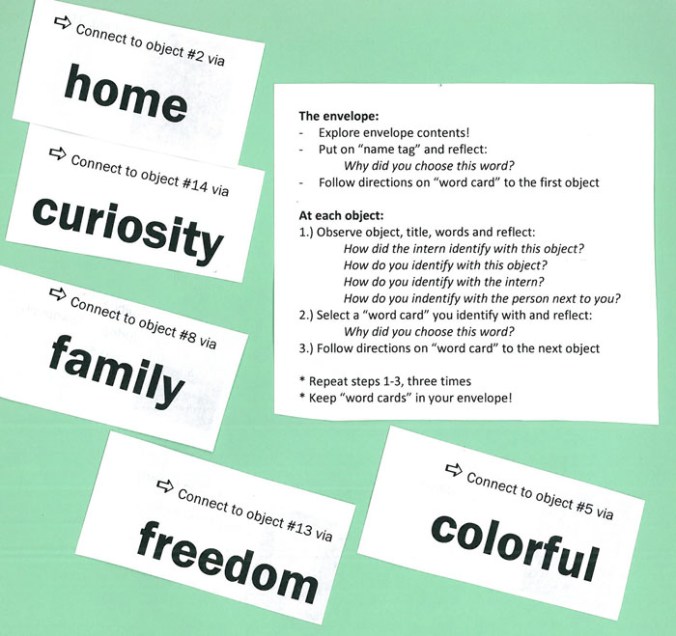
As you can see from my list, there were any number of neat themes to choose from: some had to do with the ideas expressed in each artwork chosen, others to do with the physical aspects of the artwork itself.  I did find myself redirected to the same object once or twice, so deliberately picked other words instead so that I’d have the opportunity to talk to different interns about their choices and experiences during the MAC semester.

My favorite take-away thoughts from this activity were these:

1) The level of staff or ‘visitor’ participation in this exhibit was very high, and conversations tended to be more on point than I’ve seen in some other intern exhibitions or final project presentations.

2) People tend to clump with others from their department or with whom they usually work closely, but the unusual name tags were a fun way to start a conversation with someone new.  (Or to stare surreptitiously and wonder why someone picked a certain term as their new ‘handle.’  Some were glaringly obvious, others were more of a head-scratcher, and that was fun.  It’s a great ice breaker and one I’d definitely like to re-use when I get an opportunity.)

3) Some of the staff members found the directions confusing or convoluted, presumably because they missed one of the group introductions to the activity which were provided by the interns themselves.  A little more signage outside the exhibit might have helped those who didn’t realize they had instructions in their envelopes as well.

4) The idea of ‘tagging’ a group of artworks with similar ideas or physical aspects would be a great way to talk about themes and looking at art with kids, either using examples from museums or their own artworks generated in class.
A Dynamic Mess of Jingling Things

Despite my oft-stated claim that I find just about everything interesting, I can honestly say that I’ve never been a big fan of quantum physics, except as a useful bit of technobabble in some of my favorite science fiction.  However, what Geordi LaForge, Samantha Carter, and John Crichton hadn’t quite convinced me of, a handful of *real* scientists with the assistance of the Symphony of Science did.  I now really want to go find out what those ’12 particles of matter, 4 forces of energy’ are, and meanwhile, like Rachel Maddow, I can’t stop humming this song.  Enjoy!

More Physics Fun:

“Multiverse” theory suggested by microwave background — My favorite sci-fi plotline strikes again, but this time with the weight of real science behind it, courtesy of the BBC

Exploratorium Science Snacks by Subject — One of my go-to spots for cool experiments with everyday activities.  No quantum physics there, but lots to explore with the 4 forces of energy!

Happy First Day of the Month of Thoth

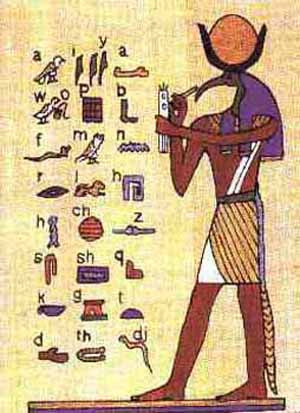
The month of Thoth in the ancient Egyptian calendar marks the beginning of a new year.  Seeing as the beginning of the school year has always felt like the true ‘new year’ to me, and I’ve always rather liked old ibis-headed Thoth, god of knowledge, it seemed like a good day to celebrate.

In the spirit of school, and knowledge, and ancient Egypt, I thought I’d share some of my favorite resources for all things Nile:

The Giza Archives Project — Hosted by Boston’s MFA, this is an incredible resource based on Reisner’s excavation notes and records from the years he spent at Giza.  I got to work on this project in college briefly and it was a great experience.  (Not to mention a really fun excuse to wander the bowels of the MFA.  Cool stuff down there!)

Archaeology Games for Kids — Recommended games and activities collected by a teacher which span not only Egyptian but other early cultures and myths including Greek and Roman.

Ancient Egypt — A comprehensive guide put together by the British Museum, the navigation could use a little work but the information’s great.

Hieroglyphs — Everything from an explanation of the alphabet to understanding Eye of Horus fractions, with downloadable guides, fonts, and worksheets (some free, some for payment).

Do you have any Egyptian resources to recommend?  Let me know and I’ll add them to the list!

Poetry and Puddles

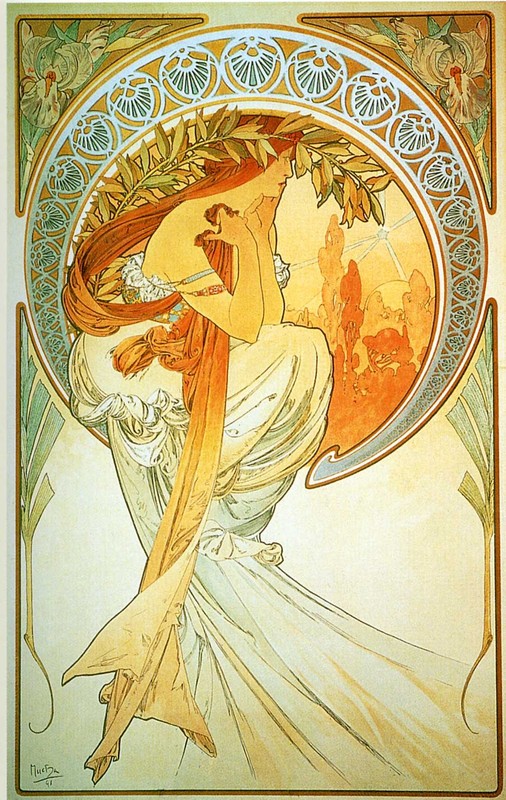
"Poetry" by Alphonse Mucha

Happy National Poetry Month, all!  April is always one of my favorite months, not only because it rescues New England from the bitter drear that is March, but because there are suddenly people talking about poetry all over.  Here’s a collection of some of my classic links and a few new fun opportunities:

Reading Poetry

30 Poets, 30 Days Blogger and author Gregory K. features a new poem a day by well-known poets on his kids’ literature blog, Gotta Book!  Always a fascinating read.

Famous Poets in 140 Characters The New York Times asks 4 poets to write poems that would fit in a tweet.

Writing Poetry

Your Ode to the Big Blue run by the Smithsonian in connection with their Ocean Hall.  Submit an ocean-inspired poem at the link or on their facebook page.  Selected poems will be posted on the Smithsonian blog at the end of the month.

Poem a Day Challenge run by Robert Brewer, a poet and blogger for Writer’s Digest.  Fun, challenging, eyebrow-raising, and entertaining, he’s posting  a poem writing prompt every day this month.

Upcoming Poetry Events

Massachusetts Poetry Festival, May 13-14

Poetry Events by State at Poets.org

A Bit of Inspiration

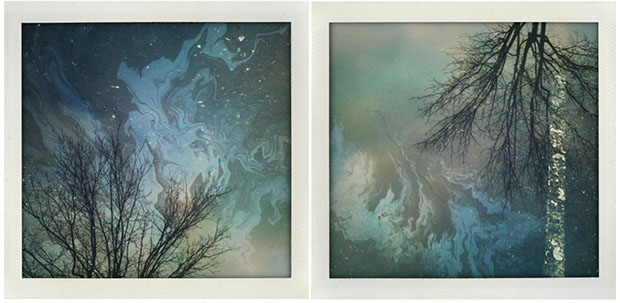
from the series "Pavement Trees" by Ingrid Nelson

See the world from upside-downish!  Check out these beautiful photographs of puddle reflections by photographer Ingrid Nelson.

in Just-
spring       when the world is mud-
luscious the little
lame balloonman 

whistles       far       and wee 

and eddieandbill come
running from marbles and
piracies and it’s
spring 

when the world is puddle-wonderful 

the queer
old balloonman whistles
far       and       wee
and bettyandisbel come dancing 

from hop-scotch and jump-rope and 

it’s
spring
and
the 

goat-footed 

balloonMan       whistles
far
and
wee 

e.e. cummings

Back from Hiatus and Happy Dr. Seuss’s Birthday

Hello all!  Thank you for patiently bearing with my silence.  Health issues and a very busy post-holiday work schedule disrupted the posting of Brain Popcorn, but we’re back to a weekly update schedule just in time to gear up for that spring that everybody is so desperate to reach.

(In fact, I’m just about ready to strap on some jetpack skates to see if I can get to spring any faster.)

Antonio Pirrello's gasoline-powered roller skates, featured on the National Museum of Rollerskating. Click for link.

(I love those skates.  They have a conveniently and appropriately Seussian look to them, too.  On Beyond Zebra, indeed!)

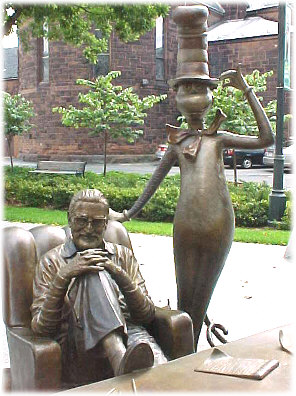
Today is also Dr. Seuss’s Birthday, celebrated here in the U.S. with Read Across America Day.

Theodor Geisel and one of his creations, at the Dr. Seuss National Memorial in Springfield MA

On March 2, the National Education Association calls for every child to be reading in the company of a caring adult.

In the spirit of Read Across America (Oh the places you’ll go!), I offer up an illustration from How to Be an Explorer of the World: Portable Life Museum, by Keri Smith.  Happy Birthday, Dr. Seuss, and thanks for the brain food!


Happy Birthday, A.A. Milne

On this winter version of a blustery day here on the East Coast, I wish you Happiness, courtesy of A.A. Milne:

Happiness

John had
Great Big
Waterproof
Boots on;
John had a
Great Big
Waterproof
Hat;
John had a
Great Big
Waterproof
Mackintosh–
And that
(Said John)
Is
That.

(From When We Were Very Young, by A.A. Milne, published 1924)

Twelve Days of Popcorn (Day 6): Play

Bubble solution.  A snail tape dispenser.  A bouquet made of pasta flowers.  A solar powered toy car.  A squishable foam donkey.  Wizard’s Potion.  Pop up books.  Poetry by A.A. Milne.  A sign that says “Please do not throw confetti in the museum.”

My desk has a high fun quotient.  So does my job.  Going to toy stores is research and tossing around a fuzzy yellow rubber ball is teacher professional development.  This does not mean I don’t have stacks of books on state curriculum standards, reference materials, and more files than you can shake a stick at.  But fortunately, the people I work with understand that innovation, education, and play go together like ice cream, brownies, and chocolate sauce.

So it is with great pleasure that I get to point you towards a fabulous article by the House Masters of Pforzheimer House at Harvard, who are encouraging a broader understanding and use of play in all stages of education: “Want to get your kids into college? Let them play.”


The real “readiness” skills that make for an academically successful kindergartener or college student have as much to do with emotional intelligence as they do with academic preparation. Kindergartners need to know not just sight words and lower case letters, but how to search for meaning. The same is true of 18-year-olds.The real “readiness” skills that make for an academically successful kindergartener or college student have as much to do with emotional intelligence as they do with academic preparation. Kindergartners need to know not just sight words and lower case letters, but how to search for meaning. The same is true of 18-year-olds.


Twelve Days of Popcorn (Day 5): All the World’s a Stage

I’ll save my thoughts on the importance of an educator’s being a ham for another day, but for today I’d like to highlight the magic that is live theater, from playing ‘dress-up’ in your backyard to setting King Lear on the Moon (okay, that I’ve never seen, but wouldn’t you like to?).  Here’s a collection of fun and fascinating links for you on theater, puppetry, and the Bard:

Make Your Own:

Jim Henson on making Muppets from things you find around the house.

A lesson plan on making shadow puppets in the classroom.

A video tutorial on making joints for shadow puppets (which has proved very useful for Eye Spy art activities this year!)

A historical make-your-own: 19th century children’s paper theaters on exhibit at the Bruce Museum in Greenwich, CT.

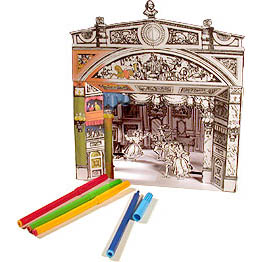
Download a pdf of a paper theater to color and construct yourself from London's V&A. Click for link.

Or try a modern equivalent with one of Robert Sabuda’s Peepbox PopUps.

Make You Laugh:

‘Superclogger’ commits random acts of theater from the back of a truck on LA’s crowded freeways.

A Christmas Carol re-envisioned…in Klingon.  (You’ll never appreciate Dickens until you’ve read him in the original…)

Call for Submissions: A Steampunk Shakespeare Anthology (Maybe I’ll get that King Lear on the Moon after all…)

On the fifth day of popcorn, these ideas gave me glee: five puppet theaters, four juicy questions, three chugging trains, two coral reefs, and a pop-up folding snow-bedecked tree…

Twelve Days of Popcorn (Day 4): A Better Scavenger Hunt

The kids pile off the bus, clutching clipboards and pencils.  Your heart sinks.  Is this another boringly basic ‘find the painting by Copley with a teapot in it’ scavenger hunt?  It doesn’t have to be.  Check out this great post from the Smithsonian Museum of American History’s blog: “New Take on the Old Museum Field Trip.”  Fill your field trip ‘yearbook’ with the figures of American History — Best Couple, Most Likely to Win a Medal, etc.  What a great way to spark conversations and force some actual reasoning to defend your vote!

It’s possible to do this at art and science museums too.   In an art exhibit, even with very young children, you could ask ‘what would you hang above your couch?  Why?’ and of course, there’s the fabulous ‘What if?’ which is at the core of any hands-on science museum.  Check out more recommendations for such ‘juicy questions’ at the Exploratorium’s Group Inquiry by Visitors at Exhibits (GIVE Program).  Find the directions for the Juicy Question Game and suggestions on how do do this on the exhibit floor with a family or school group.  Brain Popcorn + Juicy Questions = Great Food for Thought!

On the fourth day of popcorn, these ideas gave me glee: four juicy questions, three chugging trains, two coral reefs, and a pop-up folding snow-bedecked tree…