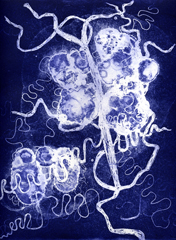
Susan Aldworth (British, b. 1955) Brainscape 18, 2006
Yes, there are more fun and fabulous examples of brain-inspired art coming to a Massachusetts museum! Landscapes of the Mind: Contemporary Artists Contemplate the Brain is running at the Williams College Museum of Art from January 30–May 2, 2010. (See the full press release here.) Being who I am, I’m particularly excited about their family day with student-led tours and art making activities in March, as well as intrigued by the fact that this exhibit, which is all about what is literally inside your head and therefore something we never see of ourselves, is tying in with the museum’s ‘year-long focus on art and landscape.’ I think there are a lot of fun parallels people could draw with other ways artists, writers, and scientists have imagined, described, and mapped what goes on in the brainscape.
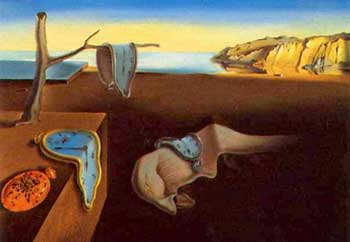
Historically, for instance, there’s all the wackiness associated with phrenology, (very popular in Victorian times). Art-historically there are those fabulous surrealists (or insert adjective of choice depending on your own opinion) like Salvador Dali. Scientifically we have all those brain-mapping studies, and virtual reconstructions through forensic anthropology, and Einstein’s brain in a jar (more than one jar, apparently).
Persistence of Memory by Salvadore Dali
Back to Lunar New Year and other fun multicultural stuff in the next post, I promise!
Disclaimer: I totally love National Geographic. You, my astute readers, will have figured that out already.
= = = = = =
My family and I spent the long weekend in Washington DC, enjoying a little respite from New England snow, and taking in (as one does, when one lives in a museum-mad family and works in a museum) the cultural sights. Though I’d love to give detailed reviews of everything (kudos to the US Holocaust Memorial Museum, for instance, for a fascinating exhibit design in “State of Deception: Nazi Propaganda” which I wish I’d had more time to explore), I’m going to focus on the original impetus for the visit, which was National Geographic’s Terracotta Warriors: Guardian’s of China’s First Emperor.
Sadly, there were no pictures allowed inside the exhibition, so I have no photos of my own to share. Fortunately, they bent the rules for their own bloggers, so there are some fabulous pictures of objects in the exhibition and at least some small sense of the layout available here. One of the things I thought they did best in this exhibit was that each element was allowed its own space: the exhibit areas weren’t over crowded, which was important given how many people were trying to view them, and where two or three statues or other artifacts were placed together, it made sense and helped advance the ideas and context which the audioguide and interpretive panels were trying to convey. It seems like a very basic and obvious thing to get right, but it’s noticeable in the traffic flow and the overall feeling and satisfaction of the visit if artworks or other objects are placed awkwardly.
There was a lot of overlap between the text panels and the audioguide, but enough difference that for the slow-paced intent studier like myself, it was worth listening and reading both. I appreciated the context provided regarding the period especially immediately before the rise of Emperor Qin, but thought (as I have thought about many exhibitions before, including the MFA’s Tomb 10A exhibit) that it would have benefited from a timeline somewhere early in the exhibit, possibly also including reference points to western/European events of the same time period, to provide that extra hook for those of us who had largely Eurocentric history educations. (For the record, NG does apparently have a video segment not featured in the exhibit anywhere which mentions a little of what was going on in Rome at the same time period, which I’ve embedded below.)
Overall, however, I loved it. I thought it was fascinating, the figures themselves were stunning displays of individuality and craftsmanship and technique, and the overwhelming impression that I left with was one of a man who commanded immense power and influence, and who, like many strong rulers in other cultures, created an infrastructure that allowed the arts to flourish. Very cool.
(Video: A reconstructed flyover of what they think the complex around Emperor Qin’s burial mound would have looked like.)
= = = = =
More fun Chinese themed posts to come as we approach Lunar New Year, but for now I leave you with the events listing for Lunar New Year at the Peabody Essex Museum, which promises to be a huge amount of fun.
I have exciting news to share with you all as a kickstart to 2010! As of tomorrow, January 11th, I will be the new Program Specialist at the Peabody Essex Museum’s Art and Nature Center!
PEM's Art and Nature Center, photo by }{enry (click for link)
I’m really looking forward to rolling up my sleeves and delving into a new set of skills and stories to learn, and bringing my hands-on experience to developing new programming and helping to design exhibit interactives and discovery boxes for the gallery space itself.
The Art and Nature Center at PEM does a huge amount of interdisciplinary education, working with contemporary artists to create year-long exhibitions which incorporate art, science, history, and culture. The current exhibition (up until late May) is called Trash Menagerie, and focuses on works of art depicting animals and other life on Earth using recycled materials. (Check out the online exhibit interactive here, which provides a world-wide look at what artists, communities, and governments are doing with green-inspired art!)
Before we launch into all the cool and exciting new stuff planned for 2010, I wanted to take a chance to wrap up some leftover business from 2009. I posted my own contributions to the New England Museum Association conference in November, and promised the slideshows from my co-presenters, Mike Adams of Boston’s Museum of Science, and Nancy Jones of Longfellow National Historic Site. Mike’s fabulous talk focused on the ways in which the MOS adds to existing programs, reworks older programs, and invites in local experts from numerous other institutions to host Archaeology Week every October. Nancy’s marvelous contribution brought art, literature, and history to the discussion, with examples of hands-on crafts, teen involvement projects, music, and a dash of poetry.

 Brain Popcorn