Putting Twitter in a Historical Context?

Wait…really?  Twitter, the ‘so new you have to be part of it to look cool’ mini-status-update gadget that half the world loves to hate already?  Twitter plus history equals something interesting?

Yup.
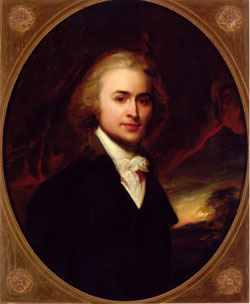
John Quincy Adams as ambassador to Russia

John Quincy Adams as ambassador to Russia

While I admit to being slightly biased about just how cool this organization is, (I worked on the interactive timeline on The Coming of the American Revolution) the Massachusetts Historical Society has gone and done something kind of fun.  This summer marks the 200th anniversary of John Quincy Adams’ voyage to Russia, to the diplomatic post appointed to him by then President Madison.  Though JQA wrote long diary entries as well, he also kept a line-a-day journal with navigational coordinates of their journey and a summary of the day’s highlights–much like today’s Facebook status updates or Twitter posts.  The MHS is doing a daily re-post of those summary entries on Twitter, and also has an overview page about the project available at their main site.

My favorite techno-gadget they’ve included is a progressive Google map tracking JQA’s progress across the Atlantic, linked from the end of most posts.

For further thought:
– What other historical figures would you love to see as a Twitterer or in some other modern guise?
– How else could you use Google maps in another context?  Historical?  To plan out the plot of a story?  Tracking sea turtles? (The New England Aquarium, another institution for which I have a positive bias, has a rehabilitation center that tracks its ‘outpatients.’)

Get lost in National Geographic

Sometime when I was a kid, an aunt bought my family a subscription to National Geographic for the year for a Christmas present, and to my glee, she has renewed it ever since.  The magazine is utterly satisfying in and of itself –the heavy pages with full color illustrations, the map inserts, the incredibly eclectic mingling of ancient history with pages of beetles with the state of modern-day Russia, etcetera etcetera.

To my equal satisfaction, the National Geographic website is similarly detailed, thoroughly engaging, and very likely to envelop your attention for hours once you start clicking on related links and intriguing pictures.  Deaf dolphins, dark energy, the history of ether–you name it, you can probably find something related to it on their website.  A treasure trove for the interdisciplinarily minded–and if you haven’t got the patience for the articles, there’s still a wealth of beautiful pictures, wallpapers, and ‘photos in the news’ to get your curiosity energized.  Or go visit the kids’ site, play the stack-attack game (horribly addicting, do not try this at work unless you have a very good excuse!), and troll the assorted stories, activities, and ‘cool clicks’ to find inspiration for your next lesson plan, program, or bulletin board.

Hint: There are also a range of newsletters you can opt-into, including ones focused on travel, photography, educators, and geography.  They do a great job of highlighting what’s new and cool on the site if you haven’t got time to put the site into your regular rotation of places to surf.

IdeaBox: Altoid Tins

ideabox altoids

In a past life, I must surely have been a magpie.  (Oooh, shiny!)  I have always been an irredeemable collector, and in my current job, I have all the excuses I need to keep bits and pieces around for inspiration.  The areas on, around, and under my desk contain feathers, stones, LEGO’s, rubber ducks, silly putty, macaroni flowers, solar powered toy cars, and a whole box of interesting shaped containers, foam pieces, springs, and whatnots.  From these pieces of rubber tubing, marbles, fabric swatches, and more, I get program and exhibit ideas all the time.

altoids

And so I bring you the fun and funky ideabox links for today: Five Reuses for Altoid Tins.  Planet Green’s top five include building tiny speakers, a solar gadget charger, a wallet, a survival kit, and a geocaching box (think I might have to try some of those!).  Or, for the more artsy among us, a watercolor traveling kit, and create your own travel candle.  (Though I wonder about the heat–I’d recommend putting it on a plate or coaster before burning!)

Here are a few other (less technical!) idea starters:

– Altoid tins are magnetic!  Turn one into a tiny on-the-road game box with magnetic pieces.  What else might you be able to do with magnets and an Altoids box (or two, or three, or more?)
– Glue a mirror in the lid and keep your kleenex in the bottom.  (Don’t you hate how those little plastic packets let your tissues get all shredded in your pocketbook?)
– Sound shakers and mini-cymbals for the extremely young musician, when you’d rather save your pans. (The round tins are particularly good for this one!)
– Start seeds in the world’s tiniest window-boxes.
– Make a fold-out mini-storybook, photo album, or travel journal with accordion-style pages.