Twelve Days of Popcorn (Day 6): Play

Bubble solution.  A snail tape dispenser.  A bouquet made of pasta flowers.  A solar powered toy car.  A squishable foam donkey.  Wizard’s Potion.  Pop up books.  Poetry by A.A. Milne.  A sign that says “Please do not throw confetti in the museum.”

My desk has a high fun quotient.  So does my job.  Going to toy stores is research and tossing around a fuzzy yellow rubber ball is teacher professional development.  This does not mean I don’t have stacks of books on state curriculum standards, reference materials, and more files than you can shake a stick at.  But fortunately, the people I work with understand that innovation, education, and play go together like ice cream, brownies, and chocolate sauce.

So it is with great pleasure that I get to point you towards a fabulous article by the House Masters of Pforzheimer House at Harvard, who are encouraging a broader understanding and use of play in all stages of education: “Want to get your kids into college? Let them play.”


The real “readiness” skills that make for an academically successful kindergartener or college student have as much to do with emotional intelligence as they do with academic preparation. Kindergartners need to know not just sight words and lower case letters, but how to search for meaning. The same is true of 18-year-olds.The real “readiness” skills that make for an academically successful kindergartener or college student have as much to do with emotional intelligence as they do with academic preparation. Kindergartners need to know not just sight words and lower case letters, but how to search for meaning. The same is true of 18-year-olds.
 

Twelve Days of Popcorn (Day 5): All the World’s a Stage

I’ll save my thoughts on the importance of an educator’s being a ham for another day, but for today I’d like to highlight the magic that is live theater, from playing ‘dress-up’ in your backyard to setting King Lear on the Moon (okay, that I’ve never seen, but wouldn’t you like to?).  Here’s a collection of fun and fascinating links for you on theater, puppetry, and the Bard:

Make Your Own:

Jim Henson on making Muppets from things you find around the house.

A lesson plan on making shadow puppets in the classroom.

A video tutorial on making joints for shadow puppets (which has proved very useful for Eye Spy art activities this year!)

A historical make-your-own: 19th century children’s paper theaters on exhibit at the Bruce Museum in Greenwich, CT.

Download a pdf of a paper theater to color and construct yourself from London's V&A. Click for link.

Or try a modern equivalent with one of Robert Sabuda’s Peepbox PopUps.

Make You Laugh:

‘Superclogger’ commits random acts of theater from the back of a truck on LA’s crowded freeways.

A Christmas Carol re-envisioned…in Klingon.  (You’ll never appreciate Dickens until you’ve read him in the original…)

Call for Submissions: A Steampunk Shakespeare Anthology (Maybe I’ll get that King Lear on the Moon after all…)

On the fifth day of popcorn, these ideas gave me glee: five puppet theaters, four juicy questions, three chugging trains, two coral reefs, and a pop-up folding snow-bedecked tree…

Twelve Days of Popcorn (Day 4): A Better Scavenger Hunt

The kids pile off the bus, clutching clipboards and pencils.  Your heart sinks.  Is this another boringly basic ‘find the painting by Copley with a teapot in it’ scavenger hunt?  It doesn’t have to be.  Check out this great post from the Smithsonian Museum of American History’s blog: “New Take on the Old Museum Field Trip.”  Fill your field trip ‘yearbook’ with the figures of American History — Best Couple, Most Likely to Win a Medal, etc.  What a great way to spark conversations and force some actual reasoning to defend your vote!

It’s possible to do this at art and science museums too.   In an art exhibit, even with very young children, you could ask ‘what would you hang above your couch?  Why?’ and of course, there’s the fabulous ‘What if?’ which is at the core of any hands-on science museum.  Check out more recommendations for such ‘juicy questions’ at the Exploratorium’s Group Inquiry by Visitors at Exhibits (GIVE Program).  Find the directions for the Juicy Question Game and suggestions on how do do this on the exhibit floor with a family or school group.  Brain Popcorn + Juicy Questions = Great Food for Thought!

On the fourth day of popcorn, these ideas gave me glee: four juicy questions, three chugging trains, two coral reefs, and a pop-up folding snow-bedecked tree…

Twelve Days of Popcorn (Day 3): Trains

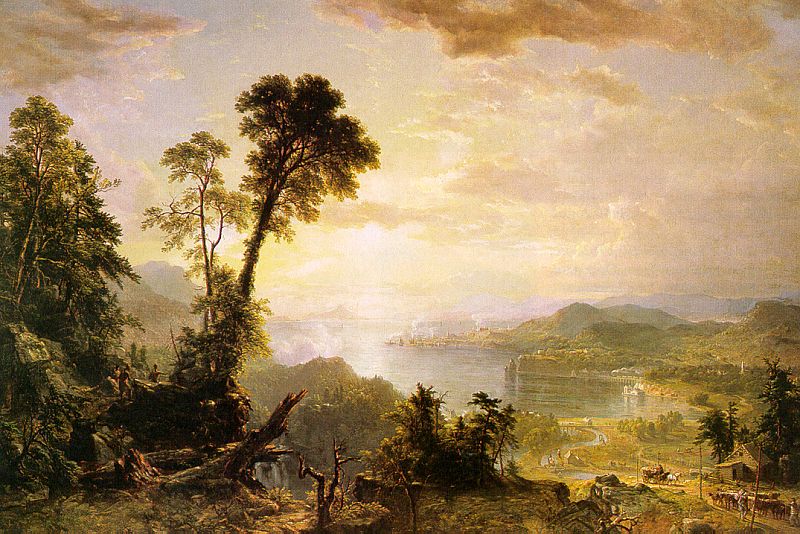
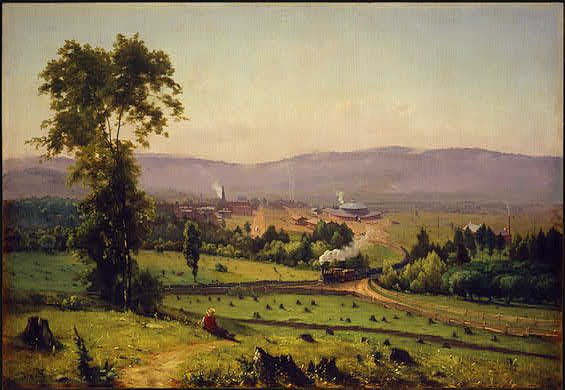
We set up the HO trains under the family Christmas tree this weekend, which is always fun and knocks about twenty years off my apparent age.   It’s amazing how enduring a fascination trains can hold, whether they’re models or massive machines, still or belching smoke and whistling like a time machine.  Trains even make good bait for getting a small child through an art museum (those luminists and Hudson River types often had creeping inroads of steam power in their paintings, after all, and you can enjoy the brushwork and color while the kiddo bounces around looking for train tunnels).

George Inness’ Lackawana Valley

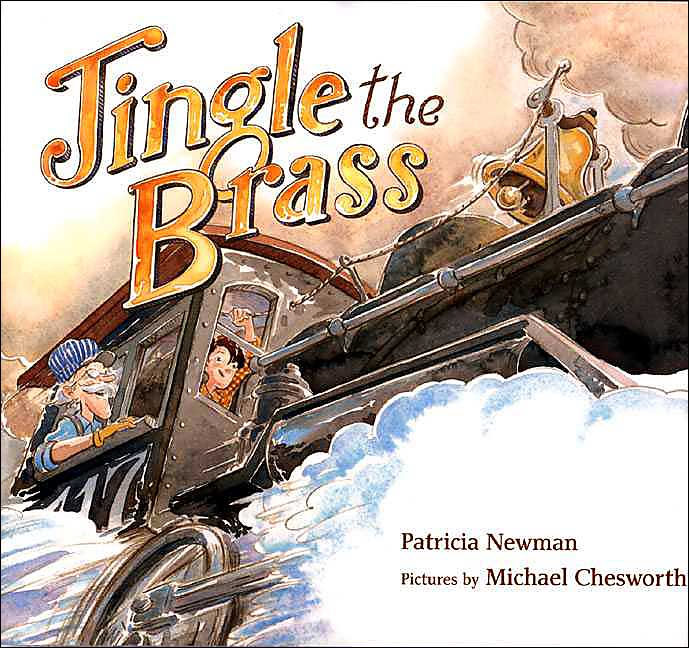
So it was with great delight that I discovered OurStory, a website hosted by the Smithsonian’s National Museum of American History.  The site is a family- and teacher- friendly resource for approaching history from the ‘story’ angle.  There is a searchable booklist, a great thematic list of activities to do at school or home, and one of their current features on the homepage is a downloadable packet of ideas and activities to explore the world of trains in your own backyard, from the local train station to the nearest rail museum.  (And even more book suggestions and activities on the thematic ‘trains’ page.)

One of NMAH's recommended reads

The NMAH has, of course, an impressive transportation collection of its own, but I love the fact that they’ve created resources which reflect the geographically wide-spread nature of visitors to a website.  “Can’t get to the NMAH?  Here’s how to find cool similar stuff near you.”  Fabulous.  Site specific materials can be fantastic, but accessibility is key.

Asher Durand, Progress (The Advance of Civilization), 1853

Twelve Days of Popcorn (Day 2): Underwater Art

It’s far too nippy here in New England to dig out the SCUBA gear, but a girl can dream, especially when faced with some truly beautiful marine-inspired artworks.

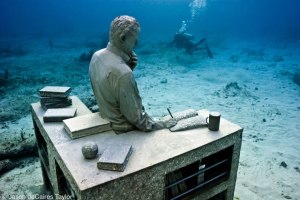
British sculptor Jason deCaires Taylor creates artificial coral reefs, not by submerging old train cars, buses, and other mechanical detritus as is often done elsewhere, but instead by creating beautiful sculptures which evolve over time as they are colonized by marine creatures. These underwater sculptures can be beautiful, spooky, or strange, but are always compelling, from their pristine state to their eventual end as the heart of a new kind of natural beauty.

The Dream Collector, by Jason deCaires Taylor. Click for link to original image.

And for those of you who prefer to keep your feet dry while checking out marine art, there is the incredibly cool collaborative crafting of the Hyperbolic Crochet Coral Reef, currently on display at the Smithsonian.  Based on the brain child of mathematician/professor/artist Daina Taimina, who first figured out how to use crochet to create this kind of mathematical form, others have gone on to build huge reefs including the Smithsonian’s Community Reef, which took contributions from interested participants in the DC, Maryland, and Virginia area.

On the second day of popcorn, these ideas gave me glee — two coral reefs and a pop-up folding snow-bedecked tree…

Twelve Days of Popcorn (Day 1): Seasonal Papercraft

In recognition of the holiday season, I have decided to celebrate with twelve posts of things that make me happy, inspire me, make me think, or otherwise stick alluringly in my brain.  (Expect a bit more humor and a bit less curriculum!)

Today’s Topic: Seasonal Papercraft, with a highlight on origami and snowflake making

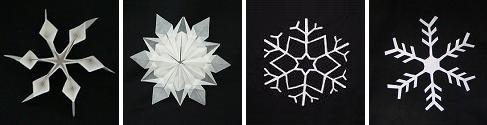
Photos from the Origami Resource Center

Round Up of Origami Snowflakes and Snowmen directions from the Origami Resource Center.  Very cool stuff.  I love the idea of using wax paper or patty paper so that you get the layered translucent snow-like effect.

Decorating the Origami Tree at the American Museum of Natural History:

Photo by snowflake designer, see link for details

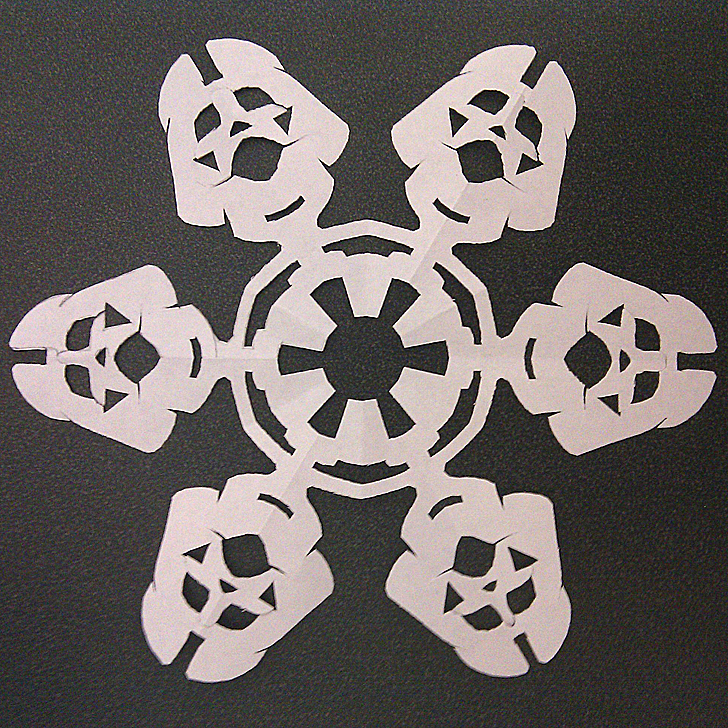
How to Make Star Wars Paper Snowflakes

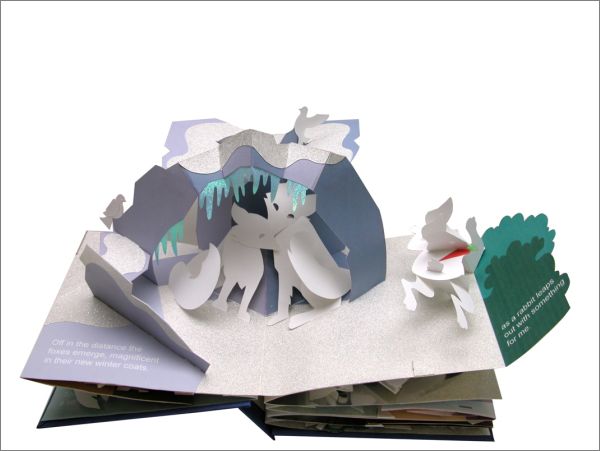
Robert Sabuda’s Winter’s Tale, a pop up book that makes me happy every time I open it.  His site has templates for creating all kinds of cool pop ups as well.

A page from Robert Sabuda's Winter's Tale


On the first day of popcorn, this idea gave me glee–a pop-up folding snow-bedecked tree…