Hunting Reflective Surfaces: Eye Spy Opening Day Preparations

As some of you may have realized, my longer-than-usual break between posts has been occasioned by the looming approach of Saturday’s opening day for the Art & Nature Center’s new exhibition, Eye Spy, Playing with Perception.  This show features a variety of artists, techniques, and ways of thinking about how and why we see and perceive the world the way we do.  As this is a year-long show, I’m going to limit myself today to talking about some of the very cool pieces that use mirrors, and one of the activities I have planned for opening day.

One artist featured in Eye Spy whom I’ve mentioned before is Devorah Sperber, who does remarkable things with thread.  We have three of her works in Eye Spy, one of which is not only pixellated into thread spools and hung upside down, but is also an anamorphic distortion, meaning that it is warped to a very particular angle so that it can only be deciphered through looking at a half-spherical mirror.
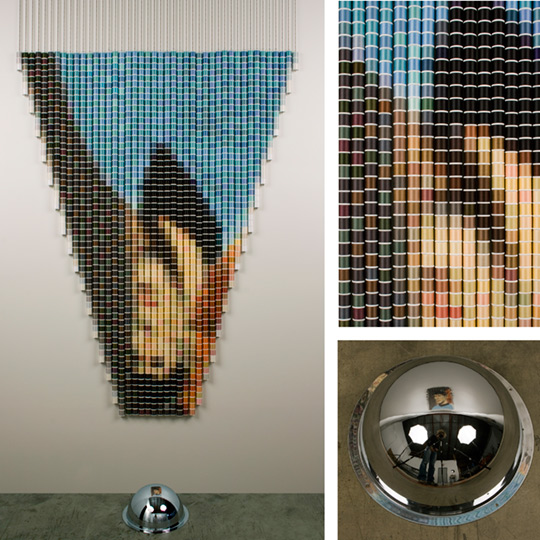
Sperber's anamorphic Spock

Sperber's Spock 2 (anamorphic), 2007, *1,702 spools of thread. Not the anamorphic work we have in the show, but awesome in its own right. Click to see more of Sperber's "Mirror Universe" works.

Another artist who does remarkable things with mirrors is Daniel Rozin, whose pieces Self-Centered Mirror and Mirror Number 5 are featured in Eye Spy.  (You can see a shot of Self-Centered Mirror on the PEM Eye Spy exhibition page linked above.)

Therefore, one of the activities we’ve planned for Saturday involves sketching your own anamorphic portrait.  Not only will we have two funhouse mirrors to play with your reflection, but we also wanted smaller, cool ‘shiny’ stuff that you could hold and examine your reflection while sketching your warped self.  (No judgment in that adjective, merely a comment on the convex and concave!)
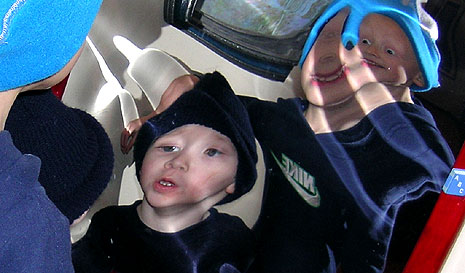
Photo credit to "Brendan Alexander's Perplexing Times." Click for link.

Here’s the question…where do you find shiny stuff that will give you those cool reflections, clearly enough that you have a prayer of sketching the result?  The secondary question is…how do you do that without spending oodles of money?

Having discovered to my dismay that not all spoons are anywhere near reflective enough, I embarked on a shiny-surface hunt, accompanied by one of the most creative people I know, who prefers to remain anonymous.  Our first stop was the local dollar store, which was not as helpful as I hoped–however, we did locate some reasonably shiny spoons, 4 for a dollar, a kid’s pair of mirrored sunglasses, and two cosmetic mirrors that had a normal side and a magnifying side.  Total output, about 8 bucks.  Not bad, but not anywhere near enough.

Next stop, thanks to my creative consultant, was the local hardware store.  Two women walking into a hardware store is a perfect opening for any number of well-meaning and only occasionally condescending offers of assistance from the folks who work there, and this trip was no exception.   Imagine, if you please, my utter delight in telling the clerk who offered his assistance that I was looking for ‘shiny stuff.’  He looked at me like I had three heads–and when I went on to explain what I needed it for, he continued to look at me like I had three heads, and had also hit him over the head with a 2×4.  (I love getting reactions like that.)  Meanwhile, while he was telling me that they were really more ‘focused on practical stuff’ and that he doubted I’d find anything, my creative consultant was peering around into the next aisle and beginning to call out all kinds of cool stuff she was finding.

Score one for the educators.

Final haul from the hardware store (after regretfully passing over some very cool and very expensive chromed faucets and other fascinating bits and pieces) included concave drawer handles, stovetop reflectors of a few different sizes, and a few lengths of chromed pipe, including one that is shaped like a U.  (I’m looking forward to handing that to some kid and saying ‘look, you’re on U-tube!’ tomorrow.)  So now I have a basket of stuff–come and sketch tomorrow!

…And if you’re not feeling up to that, check out our custom-made anamorphic puzzles, in which you can’t assemble the warped puzzle pieces and make sense of the image that results without using a cylindrical mirror.
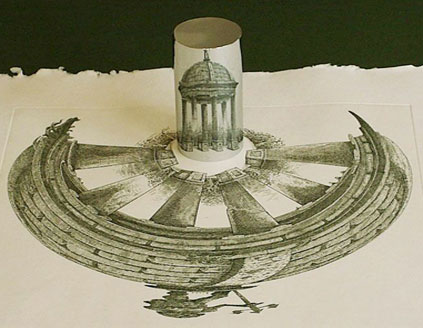
One of the historical anamorphic sketches that was the inspiration for our Anamorphic Puzzlers!

Words of Wide Open Thought

Happy first day of June!  To celebrate the beginning of a new month I thought I’d break out some of my favorite quotes in praise of the phenomenon that is brain popcorn:

“A human being should be able to change a diaper, plan an invasion, butcher a hog, conn a ship, design a building, write a sonnet, balance accounts, build a wall, set a bone, comfort the dying, take orders, give orders, cooperate, act alone, solve equations, analyze a new problem, pitch manure, program a computer, cook a tasty meal, fight efficiently, die gallantly.  Specialization is for insects.”
-Robert Heinlein, Time Enough For Love

“Don’t ask what the world needs. Ask what makes you come alive, and go do it. Because what the world needs is people who have come alive.”
~ Howard Thurman

“Logic will get you from A to B. Imagination will take you everywhere.”
~ Albert Einstein

“You can’t depend on your eyes when your imagination is out of focus.”
~Mark Twain

“I like nonsense, it wakes up the brain cells.  Fantasy is a necessary ingredient in living, it’s a way of looking at life through the wrong end of a telescope.  Which is what I do, and that enables you to laugh at life’s realities. ” ~Theodore Geisel

“Creativity represents a miraculous coming together of the uninhibited energy of the child with its apparent opposite and enemy, the sense of order imposed on the disciplined adult intelligence.”
~Norman Podhoretz

“The mind is a museum to be looted at night.” ~Raine, Craig Anthony, The Grey Boy

And to wrap it up, museum comics from Mark Parisi for a laugh, and a video from those Peter-Pan-like folks at TheFunTheory.com:

Synapses in Rhythm: Music and Brains

There’s a lot of research out there about the effect music has on the brain, and there are a fair number of misconceptions, too.  I’m not tackling the whole Baby Mozart thing here, just interested in sharing a few music-related articles that I find fascinating, plus (as always) a few good ways to play.

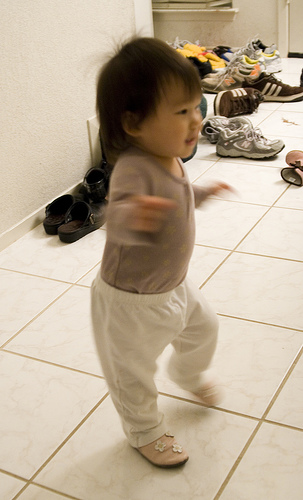
Babies are pre-programmed to dance and to enjoy it, research by the University of York has shown.

The study of 120 children aged between five months and two years found that babies spontaneously started moving to music and rhythmic beats.

Scientists also found that the better the children were at moving in time with the music, the more they smiled.

It is not known why humans have developed this predisposition, researchers said.

And here’s the rest of the article for your enjoyment and edification…Because you never know when ‘baby dance’ may pop up in casual conversation.

C'mon, doesn't that just make your day? Photo credit to benrybobenry on Flickr

For a denser look at what’s popping in the brainpan, I recommend How The Arts Develop The Young Brain.  And this month there was a neat article on a rock song writing/performance pilot program for middle schoolers in Littleton, MA which was a truly interdisciplinary project.

I also ran across a fascinating blog post this past winter over on Arts Journal about whether or not there’s a benefit to watching musicians while listening to music, or watching something tangentially related.  In this visually dominated culture I think it’s interesting to contemplate whether what you look at while you listen impacts the way you hear the same way it’s been demonstrated that what you hear influences your impression of what you’re seeing.

Music’s interesting to read about, better to listen to, and best yet to play, so if you haven’t picked up an instrument for a while (or ever) but have a hankering for raindrops, chimes, and rhythm, check out Andre Michelle’s  Pulsate, a compose-your-own virtual musical accident.  Or Tonematrix by the same artist, which allows you to build chords and adjust or remove notes in a more controlled way, for those of you who prefer deliberate composing to the pleasant effects of randomness.  The whole site is actually worth poking about in, if you  have the time: there are guitar and synthesizer activities, simple composition by pinwheel, and a number of other neat sound-related experiments and ideas.

Feeling inspired?  Directions for traditional kids’ craft level homemade instruments are here.  If you were intrigued by the Vienna Vegetable Orchestra I mentioned a few posts back, here are directions on how to make a Carrot Strummer and an Eggplant Clapper.

Want more plant-produced music?  Check out the Richmond Indigenous Gourd Orchestra (kudos to my coworker for finding these guys!).

Cartoon Brain Food

This turned up on one of my museum discussion email lists, and I had to share it with you for several reasons.

1) Cartoon characters visit a museum and get excited about the artwork instead of running through it, destroying it, or ignoring it, ala Tom & Jerry, Scooby Doo, or any number of other cartoons I could name. (Granted, the fact that it was produced by a consortium of French museums does make it more likely that the art would be more of a focus than otherwise…but it’s still great and models mostly appropriate museum behavior.)

2) In one minute the three characters manage to actually model close-looking and observation of the artwork depicted. One character knows more than the others and helps them look for details, then gives them some context for what they’re seeing.  The cartoon gets away with sounding a little condescending, which I wouldn’t really advocate, but otherwise it’s a good model for teachers, docents, or parents to follow when tying in details of kids’ lives with facts about a more distant time or culture.

3) There’s a very “I Spy” attitude to the conversation, which is a game kids love, and which I’ve been tuned into recently due to the upcoming opening of Eye Spy in my section of PEM.  I particularly love the last detail of the reflection of the man in the window, since reflections, distortions, and other plays on perception are all over the upcoming exhibition.

4) This is part of a whole series of movies which feature artworks from the participating museums, so you can do a cartoon-guided virtual tour of a bunch of very cool art .  Check out some of the others on the Louvre’s YouTube channel, at the “Jeunesse” playlist.  (Some of the videos are in French and some in English.)  Note, as far as modeling appropriate behavior goes, the characters never touch any of the art, even the really appealing lion with the movable tail.  Even I wanted to give it a yank and see what might happen!

Twitter in the History Books

Last summer I wrote about how the Massachusetts Historical Society was using Twitter to re-broadcast the daily ‘tweets’ of John Quincy Adams.  (A project which is ongoing, by the way, and still fun to find out the daily activities of this long ago Bostonian and former US President.)  And in that post, I asked “What other historical figures would you love to see as a Twitterer or in some other modern guise?” (I’d love to hear the brain-poppings of Thomas Jefferson, JRR Tolkien, or Thomas Edison, to name just a few.  “Dang! Have now invented 64th way not to build lightbulb.  Must purchase more filament tomorrow.”)  The folks at the Paul Revere House have taken up the challenge  and tweet regularly as the Midnight Rider himself at @PaulRevere1734.  And for the ironic, sad, amusing, and historically inaccurate, check out Historical Tweets: @johannesG: Finally finished invention. Disappointed to learn that no one can read. (Johnnes Gutenberg, inventor of the Gutenberg Press)

However, it now turns out that future generations will be able to find out what was on the mind of folks around the world and up and down the spectrum of celebrity — from the online and backstage shenanigans of rock stars and actors to the mundane details of what you and I thought about the recent spate of natural and manmade disasters.  Late last week, The Washington Post reported that the Library of Congress is going to be archiving all of Twitter’s public tweets, on a six-month lag (to separate ‘history’ from ‘current events.’)  Though some people are naturally skeptical (and uninterested in what Al from Boise had for lunch when he visited San Francisco on a business trip), others point out that hearing people’s off-the-cuff responses, finding out what interests them at a particular time, or evidence of casual correspondence between public figures is a historical goldmine.

Also mentioned in the article is also the benefit to populist history: taking the archives and sifting through the hashtags, etc, future historians could in fact get a real picture* of societal values and interests in an increasingly fractured “information age.”  I once heard historian and author David McCullough speak, and was incredibly struck by his statement that though we live in an age which is ‘information rich,’ future historians could easily find it ‘information poor,’ especially if and when digital records are lost.  Who writes letters by hand?  Who keeps a steady handwritten journal?  he asked.  What possible tools will the future students of the past have to understand an age where newspapers begin to disappear and half our life is lived by email?  Though it does  not solve the digital-record-dilemma, perhaps the Library of Congress Twitter archive is one way to answer his–and history’s–concerns.

*And by “real,” the article and I would both like to point out, we mean “the sections of society which are aware of and interested in a communication medium like Twitter.”  All historical sources have their context and limitations, after all!

Music, Accidentally On Purpose

*waves* Hello All!  I have returned from my trip to Italy and essentially recovered from the Italian cold I brought back with me, and I’m back on track to keep bringing you fresh Brain Popcorn.  Today’s post celebrates unusual music.

ASIMO conducts the Detroit Symphony. Click for story.

Music is a great interdisciplinary doorway.  Though I ran as far as possible from the calculations necessary for the ‘physics of music’ class they offered in undergrad, the fact remains that music and physics *are* closely linked, and so are music and art, music and history, music and literature, music and myth, music and….you get the refrain.  Today we’re going to focus on a few science connections.

Gravity Makes Music!

Gravité from Renaud Hallée: check out some very cleverly edited percussion work with falling tennis balls, forks and knives, televisions, basketballs, and light sticks.  It reminds me a lot of the number “Trashing the Camp” by Phil Collins, from Disney’s Tarzan.  (Thanks to Rob over on Politics et Alia Sensae for the heads up!)

For a slightly more complicated set of interactions (with some entertaining moments and some real physics –there’s a Newton’s Cradle in there!) check out the Rube-Goldberg-inspired “This Too Shall Pass” by OK Go.  Once you’ve watched it once and have stopped laughing, go again and keep your eyes out for levers, weights and counterweights, wedges, and a number of other simple machines.

Vegetables as instruments?

Well, it beats eating them… If you missed my earlier link to the ViennaVegetable Orchestra, here it is.  This is a great way to talk about materials engineering (what qualities are they looking for when they pick their vegetables?  How do they change those materials to get the sound they want?), and also just to discuss the ways people make noise (beating, blowing through a tube or over a tube, plucking, shaking…how do these veggie instruments resemble or differ from what a regular orchestra/band/jam session uses?).

Did you know? The palm cockatoo is known to beat hollow logs with sticks to make loud drumming sounds. ~courtesy of @AMNH, the American Museum of Natural History’s Twitter feed

Animal Music–apparently not confined to cetaceans and songbirds!  (Does anybody else have the lines from Hand, Hand, Fingers, Thumb running through their heads yet?  “Many more monkeys drumming on drums! Dum ditty dum ditty dum dum dum!”)

Earth Music

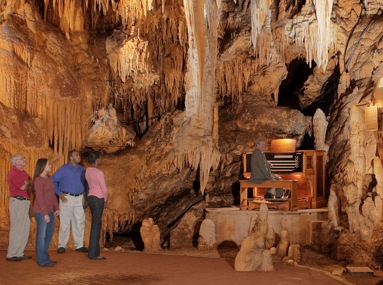
Luray Caverns Stalacpipe

The Stalacpipe Organ at Luray Caverns, photo from their website

Three years/2500 attempts = 37 formations/5 octaves = The Stalacpipe Organ.  There are so many cool paths you can take from here, looking at caves and earth science, spelunking, Virginia history, invention of musical instruments, more math and physics of sound, inspiration for creating your own tube-length-instruments.  Or just check out the site for Luray Caverns and play the audio clip.

And finally, for sheer amusement value, “Flight of the Bumblebee” played on an iPad.  Is this cheating?   Having played this piece on the flute, I’m going to say yes.  If you’re not out of breath by the end, it doesn’t count.  🙂

Fair-Weather Forts and other Sunshine Notions

It’s warming up, it’s almost school vacation week here in Massachusetts, and as the leaves are starting to unfurl I thought I’d offer up some paper-craft options for fresh-air fun.

In 1930s London, parents made up for a lack of garden space by suspending infants high outside tenements in wire cages.

That’s an idea whose time has fortunately gone by, but if you’ve got that spring-air fever, may I recommend a fair-weather fort made of newspaper?

Indulge your architectural side and build a geodesic dome out of rolled newspaper struts.  (Alternate directions also available here.)  This is a great activity in small scale or large — I’ve done it with visitors both ways, and it’s always a big hit.  Just typing this makes me want to build one in my backyard.  There’s some fun inspirational architecture-via-recyclables here: Amazing Recycled Architecture.

And while you’re into the newspaper-folding mode, and out in the backyard, try out a six-sided kite or these neat biodegradable newspaper seed-starter  pots. Or make yourself a useful newspaper basket, perfect for a picnic in your geodesic fort.

Hammocks are good. Human sized bird nests may take the cake, though. Click for further pictures!

Looking for other great recycled-material activities and a way to get out of the house next week?  Check out this list of upcoming events for Trash Springs to Life at the Peabody Essex Museum!

Popping with Poetry

If I feel physically as if the top of my head were taken off, I know that is poetry.

~Emily Dickinson

Ms. Dickinson was clearly a Brain Popcorn-style poet.  (She also reputedly said “The brain is wider than the sky,” a sentiment I quite enjoy.)  And so I am happy to say…

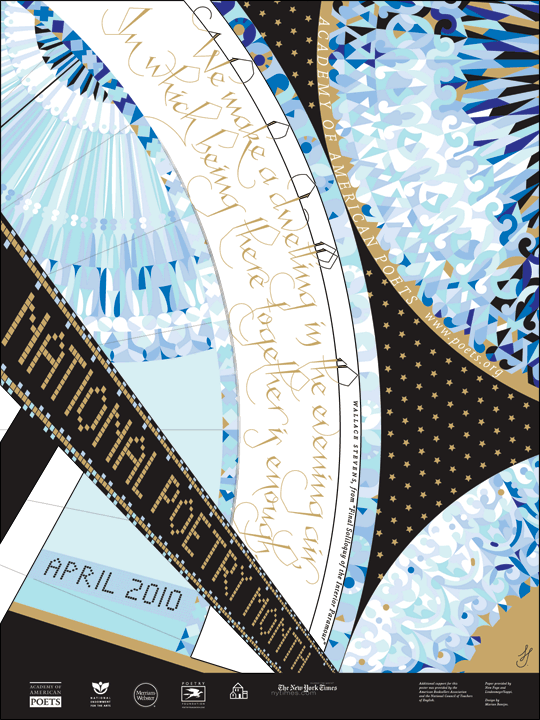
It’s National Poetry Month!  (As good a reason as any to love the fact that it’s April, just as Archaeology Month is  a grand thing to celebrate in October.)

There are a lot of very cool things going on in the world for National Poetry Month, and here are a smattering of particularly interesting and/or interdisciplinary approaches:

One Day Poem Pavilion — a very neat project, brought to deserving attention by Paul Orselli over on Exhibitricks.  This particular intersection of art and science writes a poem with sunlight and cardboard which changes as the day progresses.  Be sure to check out the time lapse video.

You Too Can Haiku — ARTSEDGE does it again!  A nice satisfying lesson plan incorporating writing, visual art, and multicultural discussion.

Michelangelo Complains in Rhyme about the Sistine Chapel — Highly amusing, even if one probably loses something in the translation.  (And it holds particular shine for me, as I’m going to Italy at the end of next week!)  This would be a really fun poem to tie in to a discussion/activity on ekphrasis.  If you’re looking for further ideas, I recommend this lesson plan over at ReadWriteThink.

MYO Magnetic Poetry Activity Plan (downloadable pdf) This is the list of materials and directions for a Make Your Own Magnetic Poetry activity that I’ve done several times at The Discovery Museums, and which will also be one of the April drop-ins at the Art & Nature Center here at PEM.  It’s entertaining, and though pre-cutting words can be time consuming, it’s very rewarding to watch people sift through the words and exclaim over the ones they find.  Small kids through teenagers and adults have fun with this one!

Finally, I would like to applaud this particular random act of poetry in a grocery store.  That kind of news just makes my day.

Brighten Your Day

It’s been raining in New England, have you heard?  I blame Chac, the Maya god of rain, who is currently taking up residence in the Peabody Essex Museum… (Amusingly, so does The Salem News.)

So if you’ve got a case of the grays, here’s a collection of fun things to lighten up your day!

“Bright Ideas: Light Bulbs Stimulate Insights” — “New research finds exposure to a bare, illuminated light bulb — a universal symbol of bright ideas — is a catalyst to reaching insights. ” (Ah, but does it work with CFLs?)

Re-using Lightbulbs as Mini-Terrariums Surprisingly pretty! And a neat statement about going green.  (Definitely does not work with CFLs! Can you imagine a teeny tiny twisted terrarium?  You can?  Good.  Now say that back to me five times fast.)

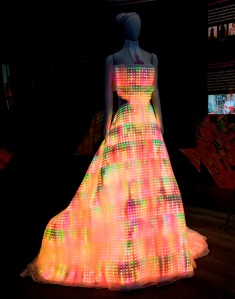
24,000 LED's, but no glass slippers

Designer Duo Create Dress with 24,000 LED’s — “We used the smallest full-color LEDs, flat like paper, and measuring only 2 by 2 mm,” say designers Francesca Rosella and Ryan Genz… “The circuits are extra-thin, flexible and hand-embroidered on a layer of silk in a way that gives it stretch so the LED fabric can move like normal fabric with lightness and fluidity.”

How-to’s and Lesson Plans on Light and Waves from the New Zealand Physics Teachers’ Resource Bank.  Lots of very cool stuff here, including a very small-scale demonstration of eye resolution and color mixing, which would be an interesting tie in to a discussion of Impressionism and pointillism, I think, as well as an explanation of how TV’s and monitors work.

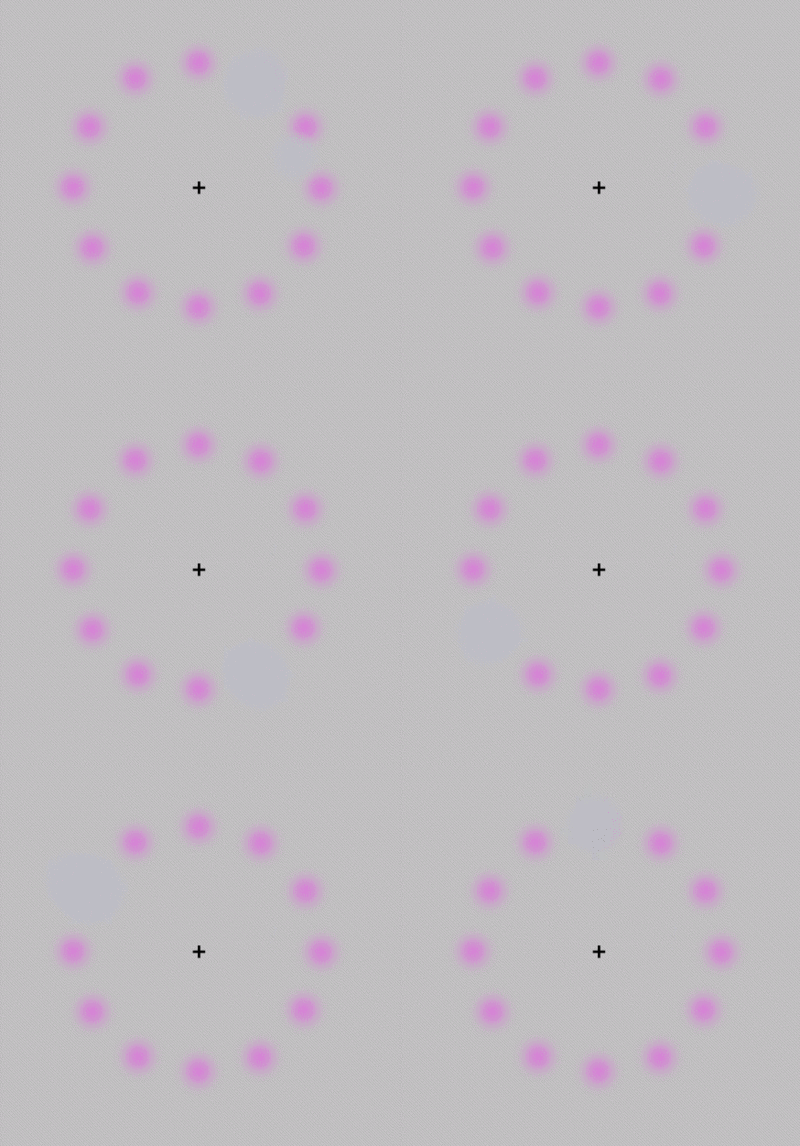
lilac chaser illusion

Look steadily at the black center of the circle. What happens to the circle of dots? Blink a few times. What happens? Click the picture for an explanation.

20 Amazing Optical Illusions — The Lilac Chaser above is #13 on the list.

Ideabox: Spools and Spindles

No princesses were injured in the creation of this post.

It’s time for another Ideabox–this time, on CD spindles and the many uses thereof, with a guest appearance by a few spools of thread.

ideabox spools

I think CD spindles are a remarkable piece of design: they’re the kind of thing that do what they’re supposed to very well, and then sit there and taunt you, gathering dust because they LOOK like you should be able to do something else with them.  If you have a few of these lying around that you’re looking to ‘upcycle’ into something new and useful, here are some ideas to get you started.  (Instructables was a really valuable resource in assembling this post.  You’ll see what I mean.)

First, a video that gives you four options in what feels like forty seconds, just to get you thinking:

Next, for the folks who can never get too organized:

  • The ‘you’re kidding, someone wrote instructions for that?’ Headphone Holder.  (Yes, they did.  But just because it’s easy and not exactly aesthetically pleasing doesn’t mean it isn’t a valid idea!)
  • The ‘I know a techie sort with too much jewelry’ CD Spindle Earring Holder.  (I know an artist who could really use this kind of display stand…)
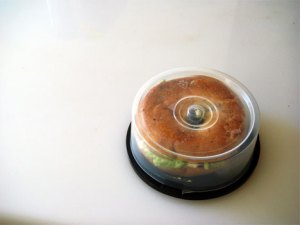
CD Spindle Sandwich

Bagelwich Buffer

CD Spindles for the Plant and Animal Worlds:

  • Flower Planters — this is a particularly cool idea if you’re trying to do a science experiment that allows you to watch the roots of things grow.  Visible carrots!
  • Mushroom Storage Case — I wasn’t sure whether to put this under ‘plants,’ ‘organization,’ or ‘huh?’ but it’s cute.
  • High Speed Silent Hamster Wheel — For the fleet of foot, but not the faint of heart.

For the Electrically Savvy:

  • CD Spindle Lamp — Gorgeous, actually.  And using an LED or CFL bulb would make it even safer.  I’d love to see a version that took up less horizontal footprint though, for the sake of those of us who live in small spaces.
  • Water-Powered Tesla Turbine — There are a number of variations to this idea provided by ‘mrfixits’ on Instructables.  They’re all fascinating in a ‘how do you come up with these things?’ way.  I love the idea of using recycled materials and water power and magnets to talk about generating electricity, though.  (And on that note, a similarly cool variation, A Pringles Can Wind Turbine)

And finally,

Spools get to play too:

Detail from “After Vermeer 2” 2006, by Devorah Sperber. Click for link to artist’s statement.