Once a month, I lead Story Trails, a program for families on Sunday afternoons that’s targeted for kids ages 5-8 with their accompanying adults. We look closely at an artwork in one of the exhibits, read an associated story, and then head for a studio space (or other safe art-making zone) and create something inspired by the artwork, the story’s theme, the illustration style, or the associated science/history/literature component. (Remember how my middle name is ‘interdisciplinary?’) Along with whatever their creation is, participants (including adults, because grown ups get to play too) take home a set of other recommended books, interesting web links, and an activity to try at home. Sometimes we also have special guest speakers, generally local authors and illustrators, with the occasional bee-keeper or lobster fisherman.
It’s a lot of fun, it’s a lot of work, and it’s one of my favorite programs, so I thought I would share the books and art activities that I loved most from this year.
January: The Spiral Connection
Book: Blockhead, the Life of Fibonacci by Joseph D’Agnese
Exhibition Connection: Ripple Effect, the Art of H2O
Art Making: Wall hangings with Fibonacci prints – we used flowers (both silk and cut flowers will do, flatter ones like sunflowers and daisies are better), pinecones, and seashells with fabric paint on plain white bandanas (available at most craft stores), to make printed patterns that feature examples of the Fibonacci sequence in nature, and then added extra decorations with fabric markers, and hung the bandanas on dowels to create easy-to-hang fabric art for your wall.
January Story Trails handout-small
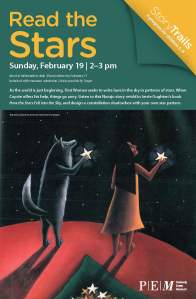
I love the ‘turning page’ look that our creative services team designed to differentiate Story Trails programming from other museum events.
February: Read the Stars
Book: How the Stars Fell into the Sky by Jerrie Oughton (retelling of a Navajo Coyote story, which is traditionally only told in the winter months)
Exhibition Connection: Shapeshifting: Transformations in Native American Art
Art Making: Constellation Light Boxes – We talked about creation stories and specifically constellation stories, and then used awls and sharpened dowels to punch holes in shoe boxes to create our own (or recreate known) constellation patterns. We then added a hole in whatever side of the box was opposite the constellation pattern to either a) hold up to our eye and then up to the light to see the stars ‘shine’ or b) put a bright flashlight into and project the star pattern into a darkened room.
February Story Trails handout
March: Cloud Factory and Guest Appearance by Illustrator Katy Bratun
Book: Sector 7 by David Weisner
Exhibition Connection: the concept of storyboarding in art, as exemplified by a series of paintings of a battle in the Maritime Art collection
Art Making: Katy Bratun led a story-boarding workshop in which kids drew a series of 4-8 panels of a story on the theme of taking a journey, and bound them into a simple book using card stock and yarn. This was a great literacy-skills support program and kids were very, very excited to share their stories with a real author/illustrator.
March Story Trails handout
April: Weslandia
Book: Weslandia by Paul Fleischman
Exhibition Connection: Earth Day, and an incredibly cool bit of textile art on view in Perfect Imbalance: Exploring Chinese Aesthetics that featured pumpkins, ears of corn, and tomatoes as exotic fruits
Art Making: Butterfly Seed Mats — We used burlap, white glue, and butterfly seed mix to create biodegradable bits of art that you could plant in a corner of your garden and grow wildflowers to attract butterflies. Simple but incredibly effective. This book happened to be requested in the previous year’s visitor survey, and happily was already on my list for potential programming.
April Story Trails handout copy
May: Sing a Song for Mothers and Family!
Book: Anna Hibiscus’ Song by Atinuke
Exhibition Connection: Mother’s Day, and inspired by both the African Art collection and PEM’s ceramics collection
Art Making: Good Cheer Jars – We mod-podged tissue paper and other bits of recycled paper onto glass jars to create good cheer jars. A good cheer jar can work any of several ways: a) a semi-voluntary fine paid when one is in a bad mood, the proceeds from which are then used to do something cheery for the family like a trip out for ice cream, b) a collection of slips of paper on which you write things that make you happy and pull one out to read when you need cheering up, c) a mandatory fine for using the household’s forbidden words like ‘I’m bored.’
May Story Trails handout copy
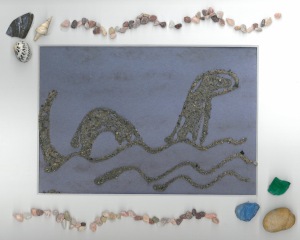
My Sea-Monster sand painting, which is still on display over my desk.
June: Beneath the Deep Blue Sea
Book: The Serpent Came to Gloucester by M.T. Anderson
Exhibition Connection: Local history and the Maritime Art collection
Art Making: Sea-Monster Sand Paintings — Using pre-cut mattes, construction paper, white liquid glue, sand, pebbles, and small sea shells and bits of sea glass, we created maritime-inspired natural collages. Some of them got very, very intricate, particularly those who decided to make mosaics of sea glass. This was one of my personal favorite art activities, and many of the adults who were at the program participated with gusto.
June Story Trails handout
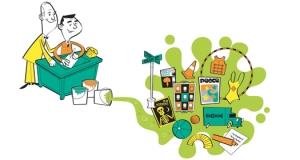
Illustration from The Day-Glo Brothers by Chris Barton
July: What a Bright Idea!
Book: The Day-Glo Brothers by Chris Barton
Exhibition Connection: Contemporary art in the Japanese Art collection
Art Making: Day-Glo (and Glow-in-the-Dark) Paintings — Using black construction paper, day-glo poster paint, and some very cool glow-in-the-dark paint, we created scenes that looked awesome in general and even better under the light of our interactive black light box. We also had samples of varying materials that kids could test to see whether or not they would react with the black light and start to glow, including beads, assorted fabrics, gelatinous substances (in safe containers), and assorted paper products. This was one of the year’s most popular programs.
July Story Trails handout copy
August: What Does the Clay Say?
Book: Dave the Potter, Artist, Poet, Slave by Bryan Collier and Laban Carrick Hill
Exhibition Connection: Ceramics in the American Art collection
Art Making: Experimenting with Clay – Though the idea was to start with pinch pots and some coil-building, clay programs always take on a life of their own. Some people made pots, others branched out into sculpture and beyond. Everyone had a fabulous time, including some adults who had missed the story and had no kids, but wanted to come work with clay anyway.
August Story Trails handout copy
September: Hats Off To You!
Book: Miss Hunnicutt’s Hat by Jeff Brumbeau
Exhibition Connection: Hats: An Anthology by Stephen Jones
Art Making: Decorate a hatbox – We used 12″ cake boxes from ULine, which fold into very decent sized hatboxes and are easy to decorate with colored pencil, stickers, collaged recycled material, and crayon.
Sept Story Trails handout copy
October: Canine Crusader
Book: Dex – The Heart of a Hero by Caralyn Buehner (alternate title Superdog)
Exhibition Connection: Hats: An Anthology by Stephen Jones and the Caps, Capes, and Characters weekend festival (organized by me)
Art Making: Superhero capes with interchangeable emblems – We used SmartFab and craft foam with adhesive velcro dots to create capes (I cut each cape to length to suit children individually), and discussed designing emblems that suited their personalities for their superhero alter egos. The velcro made it possible to rearrange or replace emblems later.
Oct Story Trails handout copy
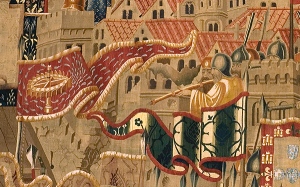
Detail from the Pastrana tapestries
November: Oh What a Knight!
Book: The Knight and the Dragon by Tomie dePaola and The Princess Knight by Cornelia Funke
Exhibition Connection: The Invention of Glory: Alfonso V and the Pastrana Tapestries and the Weaving Tales of Glory weekend festival (also organized by me)
Art Making: Tournament pennants — More SmartFab and back to fabric paint — we created jousting pennants inspired by the fabulous examples in the Pastrana Tapestries and the illustrations in both books.
Nov Story Trails handout copy
December: A Patient Brush
Book: Twenty Heartbeats by Dennis Haseley
Exhibition Connection: Perfect Imbalance: Exploring Chinese Aesthetics
Art Making: Chinese brush painting – We used rice paper (available at ACMoore or less expensively from Dick Blick), Chinese calligraphy brushes, and red and black watercolor paint, with examples from ‘how to’ books on traditional brush painting style.
Dec Story Trails handout copy
 Brain Popcorn