Two Weeks to National Fossil Day

Every time I look at my inbox and start thinking that I really need to try to cut down on the amount that lands there on a daily or weekly basis, something cool invariably arrives to change my mind.  Case in point, this morning’s email from the National Park Service announcing the upcoming arrival of the very first National Fossil Day(TM) on October 13, 2010.
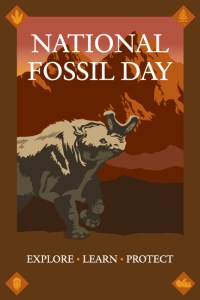
I like fossils.  I like love the National Park Service.  I had my career-epiphany-moment directly after taking a fossil hike on the rim of the Grand Canyon.

I opened the email.

So what is National Fossil Day?  Part of the 2010 Earth Science Week celebrations sponsored by the American Geological Institute, National Fossil Day  is “a celebration organized to promote public awareness and stewardship of fossils, as well as to foster a greater appreciation of their scientific and educational value.”

(In other words, a really good excuse to play in the dirt.  I always like those.)

The NPS website is a wealth of interesting information, a “rockin'” interdisciplinary list of activities, and other fascinating and fun stuff.  A few highlights include a map of the 230 national parks containing fossils (including ones in Guam and the US Virgin Islands) and fossil highlights from many of those parks,  a list of the official state fossils, and a list of events in your area.

If, like me, you take a look at all the amazing activity which is going to be on the National Mall in DC and want to cry into your Pleistocene soup from sheer envy, here are a handful of fun fossil-related activities and articles you can enjoy from the comfort of your desk chair.

Geology for Fossil Hunters, courtesy of the Exploratorium’s very cool site “Evidence: How do we know what we know? Human Origins”. Also including cool videos on virtual fossil reconstruction and other nifty topics.

Professor Allister McFragilis, Dinosaur Geo-Detective.  No, seriously. It’s an electronic field trip, or EFT put together by Bryce Canyon National Park, and has both online games and then downloadable lesson plans about geology and specifically fossils.

Dinosaur True Colors Revealed for First Time by pigments remaining in fossilized dino fuzz.

Pterosaur Ornithopter videos.  Which are apparently flying vehicles which mimic bird- or bird-like flight, specifically in this case, dino-bird-like-flight.  The key to this seems to be that the wings flap, as opposed to fixed-wing aircraft like normal planes.  Intrigued?  There is actually someone who has built and tested a successful human-powered ornithopter called the Snowbird, with a record setting 19.3 second flight, achieved just last week on September 22nd.

And, of course, more fossil fun activities and links at my previous post, “Dinosaurs, Art Photography, and Toddlers?

Holograms, Impossible Objects, and Floating Furniture

An impossible shape, the Penrose triangle, in Gotschuchen, Austria, erected in 2008 by the "physics meeting" association as part of the project "Physics on Spielplatz" Used with a creative commons license. Click for source.

Impossible Objects

In one of my recent posts I mentioned that studies have shown that we start recognizing impossible objects when very young.  Fortunately, they continue to be fascinating, and have led to amazing art, interior design, and stories like DB Johnson’s Escher-inspired Palazzo Inverso.  (I’m still holding out for a closet that’s either Narnia or a TARDIS, but while they are working on making tractor beams a reality, pocket dimensions to increase the size of my apartment are not on next year’s Christmas list.)

…Though I might want to talk to this guy: Jerry Andrus’s Illusions.  The warping clouds are enough to give you a headache, but the bolt-through-the-impossible-nuts is pretty impressive.  Even after seeing it repeatedly my brain still gets tricked.

Check out other life-sized impossible sculptures like the one above from Austria here.  Almost all of them are the sort that require you to look at them from one particular perfect vantage point: if you’re feeling inspired, there are directions on creating your own impossible triangle sculpture at Cool Optical Illusions: Penrose Triangle.

Holograms

If they’re working on tractor beams, surely holodecks aren’t far behind.  Eye Spy featured artist Betsy Connors is a holographer here in Boston, and likes to work with whole-room holographic installations, though her works currently showing at the Peabody Essex Museum are discrete elements instead of a single larger piece.  Her route to holographic creations includes lasers, a giant sand table, mirrors, film, and a multi-step developing process (see the PEM interview with her here).

If you’d like to try a similar effect without the heavy-duty equipment, William Beatty’s got detailed instructions and a lot of related links on creating what he calls a “Scratch” or “Abrasion” hologram.

Through the Looking Glass

Optical illusions are a great inspiration for unusual decoration.  These designers have gone beyond painting the roses red, however, to create chairs and couches that seem to (or maybe even will) float, exploding bureaus, room-lengthening curtains (aha!  there’s my pocket dimension after all!) and invisible tables.

Still here? After all those cool ideas?  Fine, have a book trailer for the aforementioned Palazzo Inverso, a very entertaining story you read front to back, and then upside down back to front.  And when you’re done with that, go read Mirror Mirror, which is a set of fairy tale poetry from two points of view, read down the page and then up it again.

Macaroni Commas and Two Left Feet

Didn’t get enough word fun on International Literacy Day?  Then get ready for September 24, which is National Punctuation Day.  I kid you not.

According to the official site for National Punctuation Day, this particularly exacting holiday is the brainchild of comma fiend Jeff Rubin, and is now in its seventh year of celebration.  Last year’s festivities were punctuated (ha!) by a baking contest, and this year they are soliciting punctuation-themed haiku, so go check it out if you’re feeling em dash deprived.  Don’t miss the photo gallery of punctuation mistakes–a sadly bountiful crop of terrible pluralization, but some other entertaining gaffes as well.

But why would you want to do that?  Grammar isn’t fun!

Yes it is.

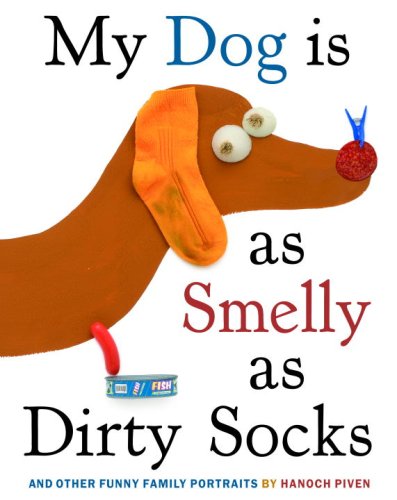
I will grant you, I don’t know if playing Punctuation Pasta with macaroni commas and quotation marks would have gotten me all excited about punctuation as a student, but looking at it now reminds me of the totally fabulous found-object illustration style of My Dog is as Smelly as Dirty Socks, which is a great way to teach grammar and figures of speech.  And I can totally imagine expanding the idea of punctuation pasta to punctuation pizza (period pepperoni, anyone?) and beyond (hence the baking contest last year, I surmise).

Punctuation is also incredibly useful in the world of solving rebus puzzles–take half the words out and replace them with pictures, and all of a sudden that apostrophe seems a lot more necessary to decoding the sentence.  ReadWriteThink has a rebus poetry writing lesson, but there are dozens more out there, and lots of cool historic examples, too.  The family of poet Henry Wadsworth Longfellow played with rebuses, and here’s one from Historic New England to test your mental mettle.

Feeling good about your visual verbal skills?  Try the BrainBats over at BrainBashers (Lots and lots of fun brainteasers over there, by the way, including some fun logic puzzles).  Or go for a more traditional grammar game experience with the Comma IQ test from the folks behind Eats, Shoots & Leaves.  You might even copy edit to your heart’s content in both Spanish and English through Maggie’s Earth Adventures, offered through Scholastic’s Teachers site.

Had enough words?  We’re back to impossible objects and scratch holograms in the next post.

Art, Astronomy, and Alien Adaptations

On my recent vacation in Maine, I spent a mesmerizing half hour or longer on the dock in front of our cabin, head tipped all the way back to take in the wealth of stars and splash of Milky Way, unsure whether I was feeling dizzy because of the depth over my head or the lake under my feet.   Add in the fact that it was during the Perseid meteor shower, and you had the recipe for perfect wonder that reminded me why I spent several years growing up convinced I was going to be an astronaut.

Fortunately for those of us who are sadly earthbound, there are folks up there willing to share the wealth: Twitpics from Space.  Not to mention NASA Spots Signs of Life…On Earth, in which some of those nifty NASA folks have figured out how to search for bacteria trapped in ice by satellite.  Next stop, Mars!

I love reading stories about what life is actually like on the International Space Station or for astronauts in general, but I get an almost equal amusement and fascination out of what people *thought* life in space could be…and how many of those ideas are still around in slightly altered forms, like eco-designer Vincent Callebaut’s floating water-purifying resort and eco-refuges for when we lose the battle with climate change (dystopic design at its prettiest).

Hear Auden read “The More Loving One” and read the text of the poem at NPR’s 100th anniversary article on Auden’s birth here.

The night sky has a kind of mystery that sometimes only artists and poets seem to be able to capture…and sometimes science helps solve those mysteries, more than a hundred years later!  Forensic astronomer solves Walt Whitman mystery (Always nice to see those interdisciplinary learners in action!)

Feeling inspired to do some stargazing?  Keep your eyes open and antennae out…the BBC reports that “Alien hunters ‘should look for artificial intelligence'” while scanning the sky.  While you wait for ET to ring the doorbell, bring the search for alien life to your classroom with the web-quest Design a Space Alien, designed for middle school students, and give your studies of earth science and evolutionary biology an extraterrestrial twist.

Happy International Literacy Day

International Literacy Day, according to the calendar hanging in my office, was technically September 8th, but as I have been having inexplicable glitches attempting to access WordPress, I’m a little behind.  (But the Salem LitFest isn’t for another week, so I’m still in the running!)

Therefore, in the name of celebrating cool stuff, which today is reading (who am I kidding?  We celebrate reading all the time in my world), I bring you neat thoughts about literacy, and a handful of reading-related activities.

First of all, good news for those of us who have more books than shelves to put them on: Book owners have smarter kids from Salon.com

And next, hear about how educators at the Eric Carle Museum focus on ‘reading the pictures’ in their storytimes as much as reading the words, improving comprehension and engaging kids and adults in the art of illustration: Noggin video

Looking for good books to read?  Ask your local librarian or check out some useful lists on Reading Rockets, helpfully organized by theme.

Also, don’t forget to check out the awesome interdisciplinary lesson plans available at the Kennedy Center’s ArtsEdge–many of them have literacy themes.  One of my favorites is the Adjective Monster, a ‘paper sculpture’ art and geometry project built around Go Away Big Green Monster by Ed Emberley.

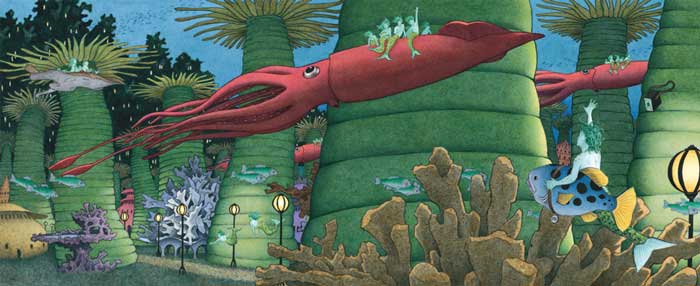
Illustration from Wiesner's Flotsam

Inspired by the ‘reading pictures’ video?  Everyone loves a good wordless book, and David Wiesner has created several.  Try out this very cool classroom photography project featured in School Library Journal and inspired by Flotsam, with neat tie-ins to science and history.  Kudos to my Anonymous Tip-Master for pointing this one out! I love how crazy and beautiful his illustrations are, and part of a long tradition of fish-exaggerations.  In 1719, the first full-color illustrated book of fish was published, including several fish that were figments of the illustrator’s imagination!  (See The Fantasy Fish of Samuel Fallours for the scoop.)

For more science tie-ins, read Flotsam paired with Tracking Trash, a very cool book about ocean currents and the problem of the ocean as ‘plastic soup’ [National Geographic].  Sector 7 is also a personal favorite, and great for teaching story-boarding or introducing a unit on clouds.

And lest we think all literacy only has to do with kids old enough for words, a neat article about visual literacy that begins developing in infancy: Escher-Themed Nurseries?  Even 4 month olds can recognize impossible objects from Cognitive Daily.  (You thought I’d manage not to include a reference to Eye Spy in this post, didn’t you?  Tune in next time for more cool stuff to do with impossible objects and how to create your own scratch holograms!)